
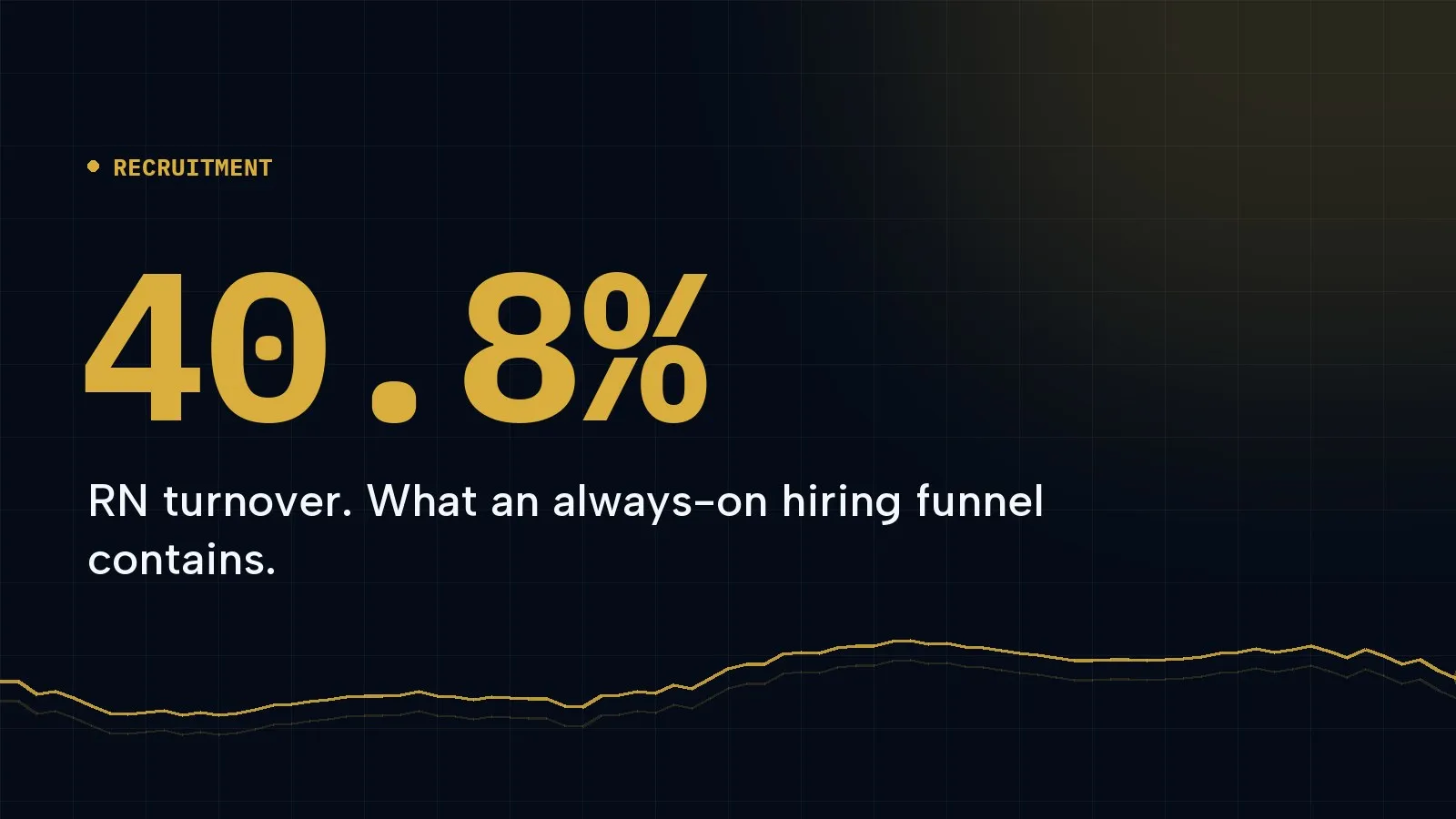
At 40.8% annual turnover, a registered nurse role is not an event you respond to. It is a rate you plan for. The same is true of CNAs at 39.0% and dining at 40.0%.
The cost case for treating this as a marketing problem is here. This post is the build: what an always-on funnel actually contains, component by component, and the failure each one exists to prevent.
Why reactive hiring cannot keep up
Post a job the day a nurse resigns and the clock looks like this: three days to write and approve the posting, seven to fourteen for enough applicants, seven for screening, seven to fourteen for interviews and offer, then two to four weeks of notice at their current employer.
That is 30 to 60 days minimum, during which the shift is covered by agency staff at a multiple of the loaded hourly cost.
Now run that four to five times a year in one building, because that is what 40% turnover means for a team of a dozen nurses. The gap is never actually closed. It moves.
The five components
1. Always-on advertising for the two or three roles that always turn over
Not a campaign. A permanent, modest budget against RN, CNA and dining, running whether or not a vacancy exists.
The objection is obvious: why advertise a job that does not exist? Because the pipeline takes 30 to 60 days and the vacancy does not announce itself in advance. A small continuous spend produces a warm list; a large reactive spend produces a cold start.
What it prevents: the 30-to-60-day gap, and the agency invoice that fills it.
2. An apply page that works on a phone, in under two minutes
Most caregiver applicants apply on a phone, often between shifts. The application has to survive that.
Concretely: no account creation, no résumé upload requirement as a hard gate, no multi-page form, no PDF. Name, phone, role, availability, licence status. Everything else can be asked later, once you have a way to reach them.
Applicant drop-off on a long form is brutal and largely invisible: you never see who abandoned. This is the same landing page discipline as a census campaign, pointed at a different audience.
What it prevents: paying for the click and losing the applicant at the form.
3. Automated screening, run immediately
Licence, availability, shift preference, distance, and right to work. These are knowable in an automated exchange and they disqualify a large share of applicants before anyone spends time on them.
The point is not to remove human judgement. It is to make sure the human time goes to the applicants who can actually be hired, and that it happens within minutes rather than days.
What it prevents: a recruiter spending a week on candidates who were never eligible.
4. Self-serve interview booking
The single highest-leverage component, and the most commonly missing.
A qualified applicant should be able to pick an interview slot themselves, immediately, without waiting for a callback. Every hour between application and a booked interview loses candidates to whichever employer replied first, and in a market where 87% of communities report difficulty hiring, someone else will reply.
What it prevents: losing qualified applicants to response time alone.
5. SMS follow-up, not email
Caregiver applicants respond to text. Email open rates in this audience are poor and the phone is the device the application came from.
A three-message sequence (confirmation, reminder before the interview, follow-up if they no-show) recovers a meaningful share of a pipeline that otherwise evaporates quietly. This is ordinary marketing automation applied to hiring.
What it prevents: the no-show rate that makes hiring managers distrust the pipeline.
The numbers to hold it to
| Metric | Why it matters |
|---|---|
| Cost per qualified applicant | Not cost per click, and not cost per raw application |
| Application-to-interview rate | Catches a broken form or bad targeting |
| Time from application to booked interview | Should be minutes, not days |
| Interview no-show rate | Directly measures whether follow-up works |
| Cost per hire vs agency cost avoided | The only comparison that matters to a CFO |
That last row is the argument. The alternative to an always-on funnel is not “no spend”. It is agency cover, and agency cover is the expensive option. AHCA reports agency use has fallen 45% from its peak, and the operators driving that decline are the ones who stopped hiring reactively.
The mistake most operators make first
They buy a job board subscription and call it recruitment marketing.
Job boards are a channel, and a reasonable one, as is social media. They are not a funnel. The board delivers a click; everything after the click (the page, the screening, the booking, the follow-up) is where the applicants are actually lost, and no board fixes any of it.
If you are going to fund one thing, fund component 4. Self-serve interview booking is a fortnight of work and it moves the number more than doubling media spend.
Fund it by role and by region
Turnover is not evenly distributed. RN at 40.8% and maintenance at 24.4% do not need the same budget, and a Midwest building at 41.9% does not need the same budget as a Northeast building at 30.5%.
A single national recruitment budget spread evenly across roles and regions is, arithmetically, underfunding the roles and markets that determine whether you can admit residents at all. We run this alongside census on one programme precisely because the trade-off between them has to be made deliberately rather than by accident.
Source: Turnover by role and region from the 2026 State of the Senior Living & Care Workforce report. Hiring difficulty and agency use from AHCA/NCAL’s 2026 workforce reporting. See the methodology page for how we handle figures we did not measure ourselves.